

2025 International activities
Against a backdrop of heightened international tensions and stable global economic growth, the international activity of the leading French construction groups increased for the fifth consecutive year (+4.8%), reaching a turnover of €90.8 billion in 2025.
For the past four years, the share of international activities in French construction companies' operations, which accounts for more than half of their total turnover (56.7% in 2025, with total revenue amounting to €160.3 billion), has continued to grow steadily.
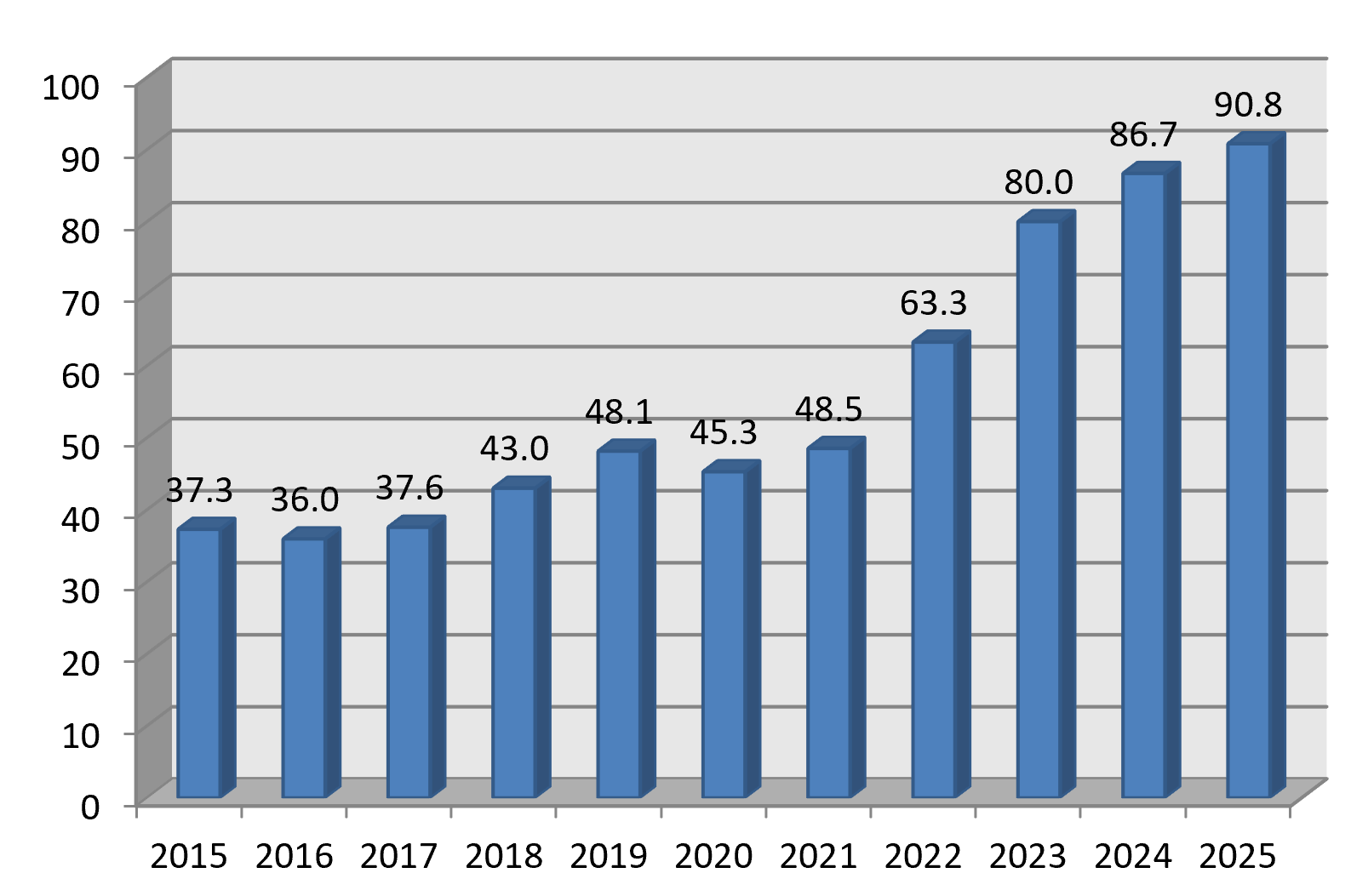
The expansion of their international activities should not overshadow the difficulties faced by construction groups, which vary in intensity across regions and countries and contribute to an increasingly tense environment fueled by significant economic and political uncertainty. These challenges include high financing costs despite lower inflation and interest rates in 2025, weak economic growth and uncertain medium-term prospects following the introduction of tariffs by Donald Trump, the ongoing real estate crisis, an investment climate hampered by uncertainty, supply chain instability, rising material prices, and increasing labor costs. Together, these factors have led to a significant increase in construction costs.
Revenue trends were relatively mixed across regions in 2025: the turnover declined slightly in North America (-0.5%) and the Middle East (-1.2%); a more pronounced decrease was recorded in Asia/Oceania (-3.4%), particularly in Asia (-10%). Conversely, other regions posted strong growth: Africa: +7.3%, Europe: +6.9% (including +9.6% in the EU-14 countries) and Latin America: +4.3%. In Western Europe (EU-14 plus the United Kingdom), the primary market for French construction companies in Europe, revenue increased by 7.5%. In Central and Eastern European Countries (CEECs), revenue growth slowed in 2025 (+3.2% compared with +4.1% in 2024). In the rest of Europe (excluding the UK), revenue grew by 4.9%.
Since the 2008 recession, the ranking of major international markets has evolved, particularly among lower-ranked destinations, although no dramatic shifts have occurred:
- Europe remains the leading market for French construction groups, accounting for 66.5% of total international revenue in 2025 (€60.4 billion).
- North America has held second place since 2012, generating €12.7 billion in revenue in 2025 (14% of international revenue).
- Asia/Oceania has ranked third since 2015, ahead of Africa. Revenue reached €6.3 billion in 2025 (7% of international revenue), including €3.8 billion in Oceania and €2.5 billion in Asia. Notably, Oceania’s share has exceeded Asia’s since 2021.
- Latin America generated €5.3 billion (5.9% of international revenue). Traditionally ranked fifth among international markets, it moved up one position in 2023 following the inclusion of Cobra IS in our sample.
- Africa now ranks fifth, with revenue of €4.8 billion in 2025 (5.2% of international revenue).
- The Near and Middle East ranks sixth, generating €1.3 billion, equivalent to 1.4% of international revenue in 2025.
Breakdown of 2025 International turnover by geographical area (in %) The evolution of the geographical distribution of the international revenue of French construction groups is characterized by:
- The dominant role of Europe: Although this trend was reinforced between 2002 and 2006 through the integration of Central and Eastern European countries into the European Union, Europe, which accounted for 66.5% of international revenue in 2025, has attracted renewed interest from French groups in recent years. This has been driven in particular by acquisitions in Western Europe, notably in the energy and industrial services sectors. Since the 2008 crisis, the contribution of new EU member states has declined significantly, making Western Europe the primary driver of business activity.
- A strong and lasting presence in North America: North America has been the second-largest international market since 2012, making it one of the French groups’ priority regions. Several growth phases, notably in 2011-2012, 2018-2019, and 2022-2023, were supported by economic stimulus programs in the United States and Canada, where infrastructure investment needs remain substantial.
- The growing importance of Oceania: Through acquisitions of local companies over recent years, French groups have significantly strengthened their position in Oceania. Combined with declining revenue in Asia between 2019 and 2022, revenue generated in Oceania has exceeded that of Asia since 2021.
- Resilience in Africa: Despite intense competition and a sharp drop in activity between 2014 and 2018, revenue has remained at a high level for the past five years. While Africa accounted for more than 10% of international revenue until 2016, it has stabilized at around 5% over the past two years.
- A diversified international footprint: While many European construction firms have progressively concentrated their international activities in only two or three markets, French groups have maintained a broad geographic presence despite economic and political uncertainties and efforts to mitigate risk. In addition to their sustained activity in Africa, they have significantly expanded operations in Latin America and Oceania through numerous acquisitions. In the Middle East, although activity declined sharply between 2015 and 2021, revenue has recovered strongly thanks to the launch of major infrastructure projects.
Thanks to the acquisitions carried out by French groups in the energy sector in recent years, particularly Vinci’s acquisition of Cobra IS in Spain and Bouygues’ acquisition of Equans, energy has become the leading business segment for French construction groups, accounting for 37.1% of total international revenue in 2025 (€33.6 billion). Transport infrastructure, which had been the leading business segment until 2021, now ranks second with 22.9% of international revenue (€20.8 billion). The other sectors are distributed as follows: Services: 16.2% (€14.8 billion), Civil engineering: 13.6% (€12.4 billion), Building construction: 7.9% (€7.1 billion) and Environment/Water: 2.3%. It should be noted that, for the first time in 2025, the share of services exceeds that of civil engineering. This development is largely attributable to the inclusion of Cobra IS and Equans in our sample.
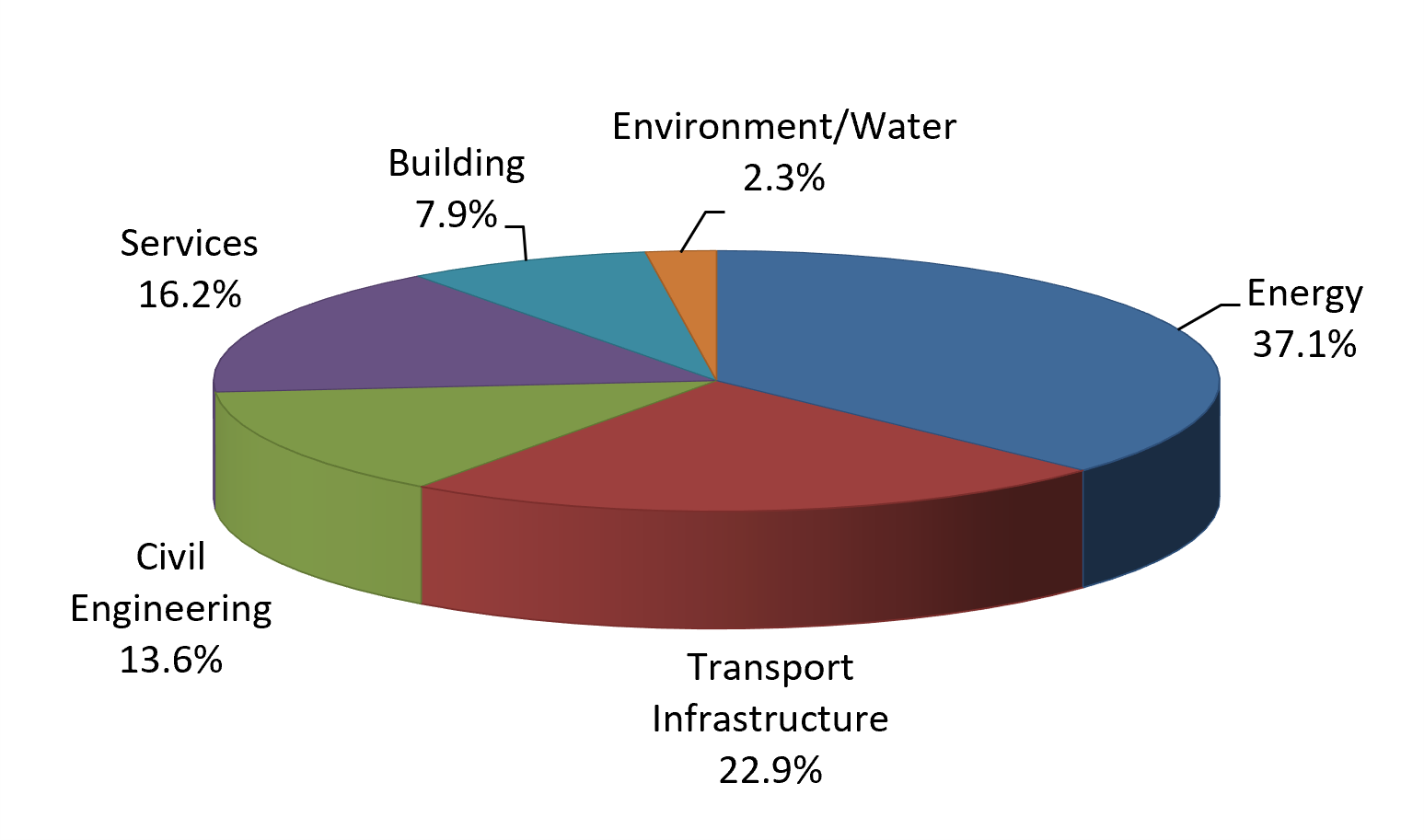
International revenue increased in most sectors in 2025, although growth was generally less pronounced than in 2024, with the exception of Services (+26.2%) and Transport infrastructure (+8.1%). Growth was more moderate in Civil engineering (+3.8%) and Energy (+0.7%). The relatively modest increase in energy follows the exceptional growth recorded over the previous four years. By contrast, revenue declined slightly in Building construction (-2.1%) and Environment/Water (-0.8%).
The evolution of the sectoral breakdown is characterized by:
- The growing dominance of energy: Energy accounted for 37.1% of international revenue in 2025, compared with less than 5% until 2005. French groups have completed numerous acquisitions in this sector since 2018, particularly over the last few years. The acceleration of the energy transition, together with the rapid expansion of activities related to information systems and data centers, has created major new opportunities for French infrastructure companies, which have actively positioned themselves in these markets.
- The strategic importance of transport infrastructure: Transport infrastructure continues to represent nearly one-quarter of total international business volume. Although revenue growth since 2015 has been less dynamic than in sectors such as energy and services, the segment still offers significant growth potential due to the substantial investments planned under recovery and infrastructure programs adopted in many countries since the pandemic. These programs are aimed in particular at addressing the challenges of climate change and the decarbonization of mobility infrastructure.
- The strong growth of services: the services sector, which encompasses facility management and concessions, accounted for 16.2% of international revenue in 2025. The sector has experienced strong growth rates since 2018. After being heavily affected by the global pandemic in 2020, revenue has risen sharply over the past four years, driven by the integration of Cobra IS and Equans and successive acquisitions of companies specializing in industrial and energy services.
- The long-term decline in building construction: the share of building construction has declined significantly over the past decade. While the sector accounted for slightly more than 20% of international revenue until the early 2000s, its share fell to 7.9% in 2025. The lowest level was recorded in 2023 (7.3%). This trend is largely linked to the prolonged crisis in the real estate sector, whose recovery remains uncertain despite continuing demand in certain market segments.